
How Our Brokenness Can Become Our Beauty
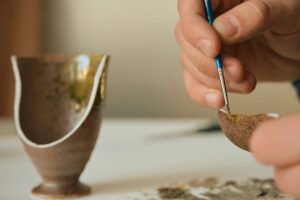
There is a Japanese art form known as Kintsugi, which means ‘golden joinery’. When a ceramic bowl or vase breaks, the pieces are not discarded. Instead, they are carefully repaired using lacquer mixed with powdered gold. Rather than hiding the cracks, Kintsugi highlights them. The fractures become part of the object’s story, transforming what was once broken into something uniquely beautiful and often more valuable than before.
Kintsugi offers a powerful metaphor for the healing of shame, as it helps us to understand how that which may have seemed beyond repair, can be restored in such a way that we can be proud of the end result.
Many of us carry wounds that were formed long before we had the language to understand them. Shame is often the hidden legacy of emotional neglect, poor communication, family dysfunction, trauma, or the absence of healthy affirmation. It develops when a child repeatedly receives the message, directly or indirectly, that who they are is somehow inadequate, unworthy, defective, or ‘not enough’.
Unlike guilt, which feels “I have done something wrong,” shame believes “There is something wrong with me.” Over time, this belief can become deeply embedded within our identity, to such an extent, we find shame in every area of our lives, and in everything that we do.
How Shame Fractures the Self
Every child enters the world with innate worth, potential, and authenticity. We develop a healthy sense of self when our emotions, experiences, and individuality are acknowledged and reflected back to us by those who care for us. Healthy affirmation, attention and affection (the 3 As) help us understand that we are seen, valued, and accepted.
When the 3 As are absent, inconsistent, or conditional, children struggle to make sense of their experience. They begin to believe that their needs, feelings, or true nature are unacceptable. In an attempt to gain love, approval, and safety, they learn to adapt to what they believe the environment wants of them.
These adaptations often take the form of what psychologists sometimes describe as false selves, or subpersonalities, which are protective identities constructed to meet the expectations of others. The child learns to suppress certain emotions, exaggerate others, become overly compliant, perfectionistic, self-sufficient, or constantly accommodating. The authentic self gradually retreats behind these protective personas.
The tragedy of shame is not simply that it hurts; it disconnects us from who we truly are. As these protective patterns become engrained, individuals can find themselves living through multiple ‘faces’ and ‘voices’ of shame: the inner critic, the procrastinator, the people-pleaser, the attention seeker, the rescuer, or the self-doubter. Each part attempts to protect against rejection or abandonment, yet each also reinforces the belief that our true self is somehow unacceptable to the world.
Eventually, we can become strangers to ourselves, living according to roles and expectations while remaining disconnected from our deeper identity.
The Kintsugi Principle: Healing Without Hiding
Many people approach healing as if it requires erasing the past. They hope that enough therapy, self-improvement, achievement, or spiritual growth will somehow remove every crack and scar. But at Reach we do not believe you can erase the past, to the contrary, you must find a way to lovingly embrace it. Our research and clinical experience repeatedly tell us that until we can love the ugly in ourselves, we are unlikely to become beautiful.
This is where Kintsugi teaches us such a beautiful lesson about healing. The goal is not to pretend the vessel was never broken. The goal is not to hide the cracks. The goal is to repair the fractures with such care, tenderness, and compassion that they become part of a new and stronger whole.
Healing from shame follows the same path. The experiences that wounded us cannot be undone. The neglect has happened. The criticism was real. The rejection has left deep scars. Yet healing begins when we stop viewing those experiences as evidence of our worthlessness and start seeing them as merely chapters in our story which do not define who we are.
Just as gold fills the fractures of a broken vessel, it’s our self-awareness, self-compassion, and supportive relationships that fill the fractures left by shame. And although those cracks remain visible, but they no longer represent defectiveness. They become evidence of survival, resilience, and growth.
The Gold That Repairs the Cracks
Kintsugi has a deep philosophical connection with wabi-sabi which also focuses on embracing imperfection, impermanence, and the incompleteness of life. Through our work we encourage living with ambivalence, which means learning to live with your contradictions and inconsistencies. When you are able to do this, transformation is made so much easier.
Although it is gold lacquer that is traditionally used, silver and platinum are also used. The lacquer in psychological healing often comes in several forms:
Self-Awareness: Healing begins when we recognise shame for what it is, a record of our experience, rather than a statement of who we are. Through self-awareness, we learn to identify the critical inner voice and understand where it originated, and we can clearly distinguish between the authentic self and the messages we absorbed from others. Consequently, we make better decisions and choices.
Self-Compassion: Research by psychologist Kristin Neff, Paul Gilbert and others has shown that self-compassion is strongly associated with emotional resilience and psychological well-being. Self-compassion invites us to respond to our wounds with kindness rather than judgment. Instead of asking, “What’s wrong with me?” we begin asking, “What happened to me, and how do I need to respond?”
Authentic Relationships: Shame thrives in secrecy and isolation. So, we need to find ways to bring it into the light. This requires courage and at times excruciating honesty. This is where healing begins. Healing also occurs when we experience relationships in which we can be seen honestly and accepted fully. Being understood by others helps restore the sense of belonging that shame has often destroyed.
Reclaiming Authenticity: As healing progresses, we gradually transform the subpersonalities/false selves that were created for survival. We become less concerned with earning acceptance, because we are now cultivating that within ourselves and we become more committed to living according to the values and principles that reflect our heart and conscience. This process can leave us feeling vulnerable, but it is also deeply liberating.
From Brokenness to Beauty
One of the most profound lessons of Kintsugi is that brokenness need not diminish value. In fact, the repaired object often acquires a status that did not exist before it was broken, hence its value often increases. The same can be said of human beings.
Those who have confronted shame often develop qualities that are forged through struggle, empathy, wisdom, humility, courage, emotional depth, and compassion. The very wounds that once seemed to disqualify them from peace of mind and joy, become sources of strength and connection.
This does not mean the pain was necessary or desirable. Nor does it glorify suffering. Rather, it acknowledges a remarkable human capacity; the ability to transform adversity into assets. Our scars do not have to become prisons. They can become pathways to freedom.
A New Approach
Shame would have us believe that our cracks prove we are damaged beyond repair, but Kintsugi tells a different story. It reminds us that fractures are not the end of a vessel’s usefulness, beauty, or worth. They simply become part of its history.
Likewise, the wounds of neglect, rejection, trauma, and emotional pain do not define who we are. They are experiences we have lived through, not identities we must carry forever.
When we approach our broken parts with honesty, compassion, and courage, we begin to fill the cracks with gold. What emerges is not the person we were before we were broken; but someone more integrated, authentic, resilient, and whole.
The aim of healing is not to become flawless. It is to become fully ourselves. And like a Kintsugi vessel, we may discover that the places where we once felt most broken become the very places where our greatest beauty and light shine through.
Also see: The Pyramid of Shame and Living With Ambivalence and Subpersonalities