
“No one can whistle a symphony. It takes a whole orchestra to play it.”
H.E. Luccock (1885–1960)
An Overview
The Story of Health is also the story of disease. They are opposite sides of the same coin. To understand one, we must understand the other.
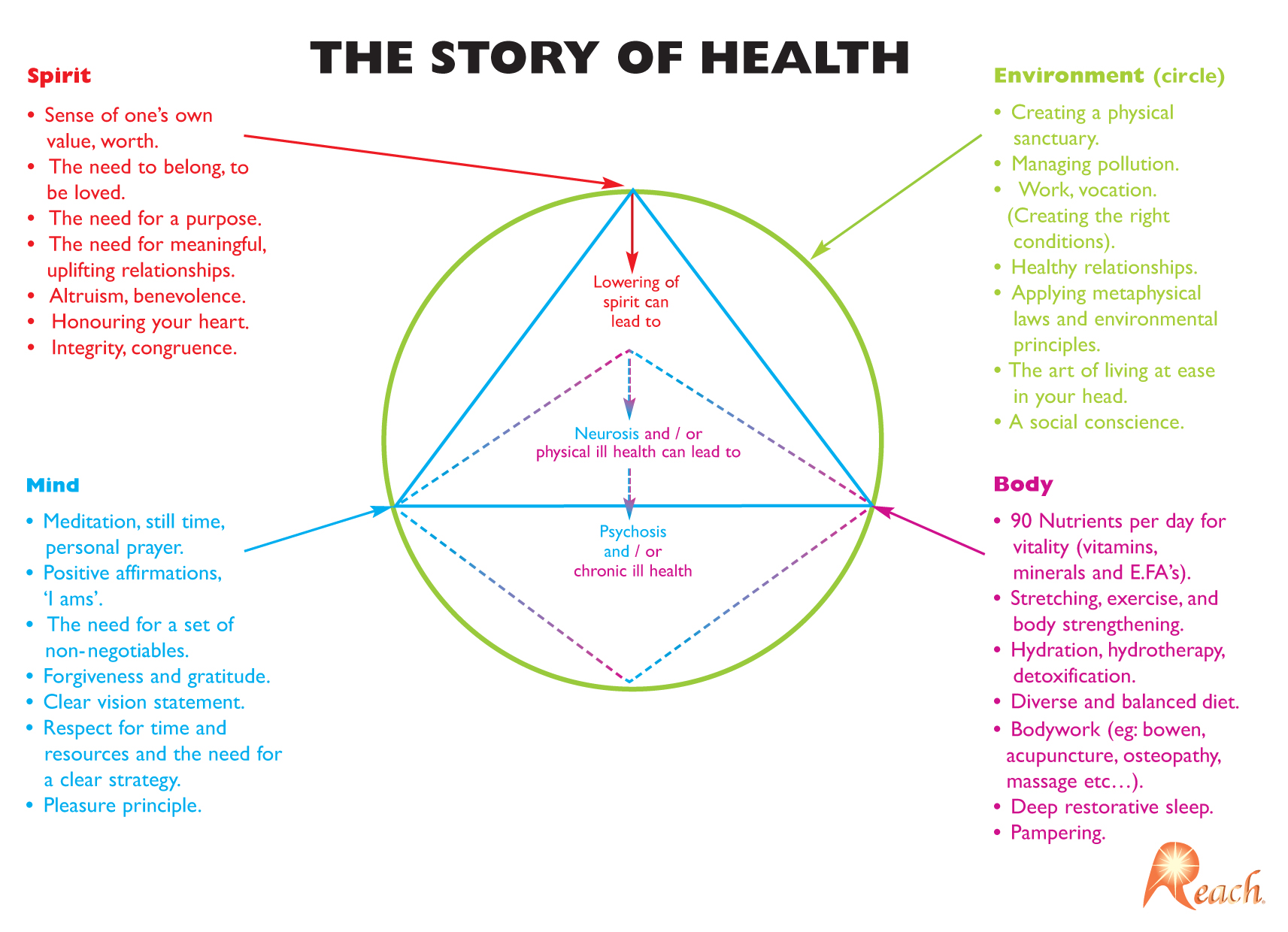
The diagram that accompanies this article will help you to understand the dynamics of the self: the intricate relationship between Mind, Body and Spirit, and the way in which all three interact continuously with the environment in which we live. Each has its own role, its own needs and its own functions, yet none exists in isolation. They are deeply and subtly interconnected, and together they create the human experience we call life.
The circle represents the Environment – the world in which we live, adapt and function. Under each of the four headings are some of the primary needs of Mind, Body, Spirit and Environment, together with some of the ways those needs may be met. This is not intended to be a definitive list. Rather, it is a framework to help us understand what may be required to bring about positive change within each aspect of the self and, in doing so, restore and protect physical, psychological and emotional health.
The equilateral triangle represents the ideal state: balance, harmony and a dynamic equilibrium between Mind, Body and Spirit. In this state, each is able to fulfil its proper role, each receives what it needs, and the forces operating within the self are held in a state of harmony and balance. There is no need for one to dominate another. Instead, they work together – as an orchestra, rather than as competing instruments.
When this harmony exists, our relationship with the environment is also more likely to be constructive and at peace. We are better able to meet life’s demands without being overwhelmed by them. We can think clearly, inhabit our bodies fully and experience a sense of meaning and direction.
The dotted triangle, by contrast, represents the beginning of imbalance – the point at which health becomes compromised and the journey towards dis-ease begins. At this stage, the self is no longer functioning as an integrated whole. One part begins to pull against another. The equilibrium created when the needs of Mind, Body and Spirit are being adequately met is disturbed, and tension begins to accumulate. This dis-ease may initially arise from tension between Mind and Body, or from a loss of direction, meaning or purpose within the Spirit. Left unchecked, dis-ease can, over time, become disease – manifesting in a biological, psychological or emotional form, and often in a combination of all three.
If the demands of the Body begin to pull the Mind away from its ideals, intentions and ambitions, the Mind may gradually lose its sense of direction. As the individual becomes increasingly preoccupied with meeting immediate physical needs or responding to physical distress, the Spirit can become diminished by the continuing struggle.
Equally, the Mind’s relentless pursuit of achievement, excellence and ambition can pull against the Body. When the body’s fundamental needs are repeatedly neglected in the service of goals, responsibilities or aspirations, biological tension begins to build. Sleep may be sacrificed, nutrition compromised, movement neglected, and recovery ignored. The eventual consequence may be physical exhaustion, dysfunction or illness – and, once again, the Spirit is deflated.
The Spirit thrives upon a sense of connection, meaning, belonging and inner peace. It needs to feel that life has value and that there is a reason for being. When the different parts of the self are continually at war with one another, the Spirit is inevitably affected. And when the Spirit falls, so too can our capacity for hope, resilience and recovery. This dis-ease can manifest very differently from one individual to another.
For some, the consequences may initially be psychological or emotional: stress, anxiety, panic, depression, phobias and other forms of distress. An individual may live within this malaise for years – conscious that something is wrong, aware of their own dysfunction, yet unable to find the means to change it.
For others, the consequences may be predominantly physical: ulcers, irritable bowel symptoms, disturbances of the immune response, disorders involving the central nervous system and a wide range of other physical manifestations. These too may be intermittent and spasmodic, or they may develop into persistent and chronic conditions.
The distinction between Mind, Body and Spirit is therefore useful, but it should never be mistaken for separation. What happens in one affects the others. A distressed mind can affect the body. A distressed body can affect the mind. And when either is persistently compromised, our sense of meaning, hope and connection – the experience we call Spirit – can begin to suffer.
Losing the Self
Neurosis could be described as losing the self, losing a sense of control over your life whilst being aware of that, yet feeling unable to halt the demise. The person can see the patterns, feel the consequences and often understand, at least intellectually, what is happening – yet still feel powerless to change it.
Psychosis, by contrast, represents a much more profound disturbance of the relationship with the self and with reality. The individual may become so overwhelmed by despair, pain, fear or hurt that their familiar sense of self appears to fragment or disappear.
It is this profound disconnection that makes severe psychological disturbance such an enormous challenge. When an individual becomes almost completely disconnected from their identity, sense of value, belonging, meaning and purpose (the Spirit) the very foundations upon which recovery depends can become difficult to reach.
Physical illness can create a similar crisis. When physical illness becomes chronic, relentless or overwhelming, it can gradually sever a person’s connection with the life they once knew. Independence may diminish. Hope may fade. Identity may change. The future can begin to appear smaller and smaller. In this way, chronic physical illness can itself become a pathway towards a loss of Spirit – a loss of hope, meaning and connection.
This is why health cannot be understood simply as the absence of disease. Health is a state of flourishing, where Mind, Body and Spirit are beautifully in relationship with one another and the Environment.
The Needs of Spirit
The spirit needs purpose – a reason for being. It needs to belong. It needs to love and to be loved. It needs to experience life as meaningful and to live according to values such as integrity, compassion, altruism and benevolence.
When these needs are honoured, we begin to discover something deeper than temporary pleasure or external success: a sustainable form of happiness that comes from within rather than being dependent upon external events and circumstances. This is what it means to honour one’s heart. It is to listen to that deeper sense of what matters, to recognise one’s values and to have the courage to live in accordance with them.
The Needs of Mind
The mind needs peace, love, clarity and structure. It needs achievable goals and objectives, together with a clear sense of direction. It needs a vision – a personal mission that gives purpose to thought and action and enables us to meet life’s challenges with courage, resilience and confidence. But the Mind also needs stillness.
There must be a balance between reflection and stimulation, between periods of quiet contemplation and engagement with the world. Without that balance, the Mind can become either stagnant or overwhelmed.
To live mindfully means to perpetually increase your awareness, and not to live at the behest of your thoughts and feelings. In doing so, you can begin to discover forms of pleasure, fulfilment and contentment that lie beyond the constant pull of the senses.
The Needs of Body
The Body needs to survive, recover and thrive. Its first responsibility is to sustain itself so that it can meet the many demands placed upon it. It requires adequate sleep and rest, movement and exercise, hydration, nourishment, recovery and appropriate care.
It needs quality nutrition and an environment that supports rather than continually undermines its biological functioning. It needs periods of relaxation and restoration, as well as physical activity and stimulation. It needs to be listened to rather than continually overridden.
When these fundamental needs are respected, the Body is better able to fulfil its potential and provide the physical foundation upon which the Mind and Spirit depend. The Body is not simply a vehicle for carrying the Mind and Spirit. It is a precious and integral part of the whole.
The Importance of the Environment
A healthy Environment provides the conditions in which the Mind, Body and Spirit can flourish. Ideally it includes creating a physical sanctuary – a place that supports safety, restoration and wellbeing, providing us with an antidote to the stresses and strains of the modern world. It also includes the work we do and the vocation we choose, and our ability to create conditions in which our talents, values and aspirations can be expressed. The environment includes the quality of our relationships, the people with whom we surround ourselves and the wider community of which we are a part.
But Environment is more than the physical world around us. It incorporates the principles by which we choose to live: an awareness of the deeper laws that govern life, the environmental principles that sustain it, and the social conscience that recognises our responsibility to others and to the world we inhabit. When the environments we create, inhabit and contribute to are aligned with the needs of Mind, Body and Spirit, they become not merely a setting for life, but an active force in sustaining health, balance and wellbeing.
The Whole
All four – Mind, Body, Spirit and Environment – are equally important in The Story of Health. Ideally, Spirit and Mind provide direction: they establish values, meaning, intention and purpose. They help determine where we are going and why. The Body then provides the physical foundation and some of the energy through which those intentions can be expressed in the world. But intention alone is not enough.
No matter how strong the Mind or how determined the Spirit, if the needs of the Body are continually ignored, or if the Environment in which we live is unable to meet our needs and is persistently hostile, it becomes increasingly difficult to maintain balance. Willpower cannot indefinitely overcome biology and the other environmental factors that support the human condition, just as positive thinking cannot always compensate for a life where the other needs of The Story of Health are not being met. This is why meaningful healing and recovery requires more than simply treating the symptoms.
We need to respond systematically, creatively and compassionately to the needs of the whole self. We need to understand what the Body is asking for, what the Mind is struggling with, what the Spirit has lost or is seeking, and what the Environment is contributing to the imbalance. When we begin to address these elements together, the possibility of transformation emerges. Then the Body can regain strength, the Mind can regain clarity, and the Spirit can regain hope.
And, as the four begin once again to work together, the self can move away from dis-ease and disease, and towards health. The ultimate aim is not only to remove dysfunction; it is to restore the conditions in which the whole person can think clearly, live fully, love deeply and pursue a life of value, meaning and purpose.
Finally, health is not a static state, but a living, dynamic ecosystem, where harmony between Mind, Body, Spirit and the Environment exists. Like an orchestra, the goal is not for one instrument to be heard above all others. The goal is for the whole orchestra to play in unison.
Also see: The Story of Health 2